Countdown Tools
How Many Days Until 2027?
A reproducible way to count the calendar days, weeks, and working days remaining before January 1, 2027.
By Vigneshwaran Vijayakumar, Developer and Publisher | | Reviewed under the ClockTools editorial policy

Table of contents
The number of days until 2027 depends on the moment you check and on one boundary choice: which local midnight counts as the start of the year. The destination itself is fixed—12:00 a.m. on January 1, 2027—but a live answer falls continuously as time passes. Open the ClockTools New Year Countdown for the current value in your browser. Use the method below when you need to reproduce the count in a plan, spreadsheet, or report.
If you only need another event date, the Holiday Countdown can build a separate live countdown. Keep “calendar days,” “complete 24-hour periods,” and “dates available on a checklist” separate: they can differ by one even when every calculation is internally correct.
What exactly are we counting?
A calendar countdown normally measures the time from now to the first instant of January 1, 2027 in a named timezone. The whole-day display is the number of complete 24-hour blocks remaining after hours, minutes, and seconds are separated. A date-list count asks a different question: how many labeled dates remain available, perhaps including today.
| Count | Start rule | End rule | Best use |
|---|---|---|---|
| Live elapsed countdown | Current instant | Local midnight starting 2027 | A timer or event display |
| Calendar-date checklist | Beginning of today, or today included by convention | December 31, 2026 included | Planning daily actions |
| Business days | Named working schedule | Last eligible workday of 2026 | Staffing or delivery estimates |
| Whole weeks | Whole days divided by 7 | Same boundary as the day count | A compact planning estimate |
These labels prevent the classic one-day disagreement. Neither inclusion rule is universally “the” correct rule; the correct one is the rule stated beside the number.
How can you calculate the days until 2027?
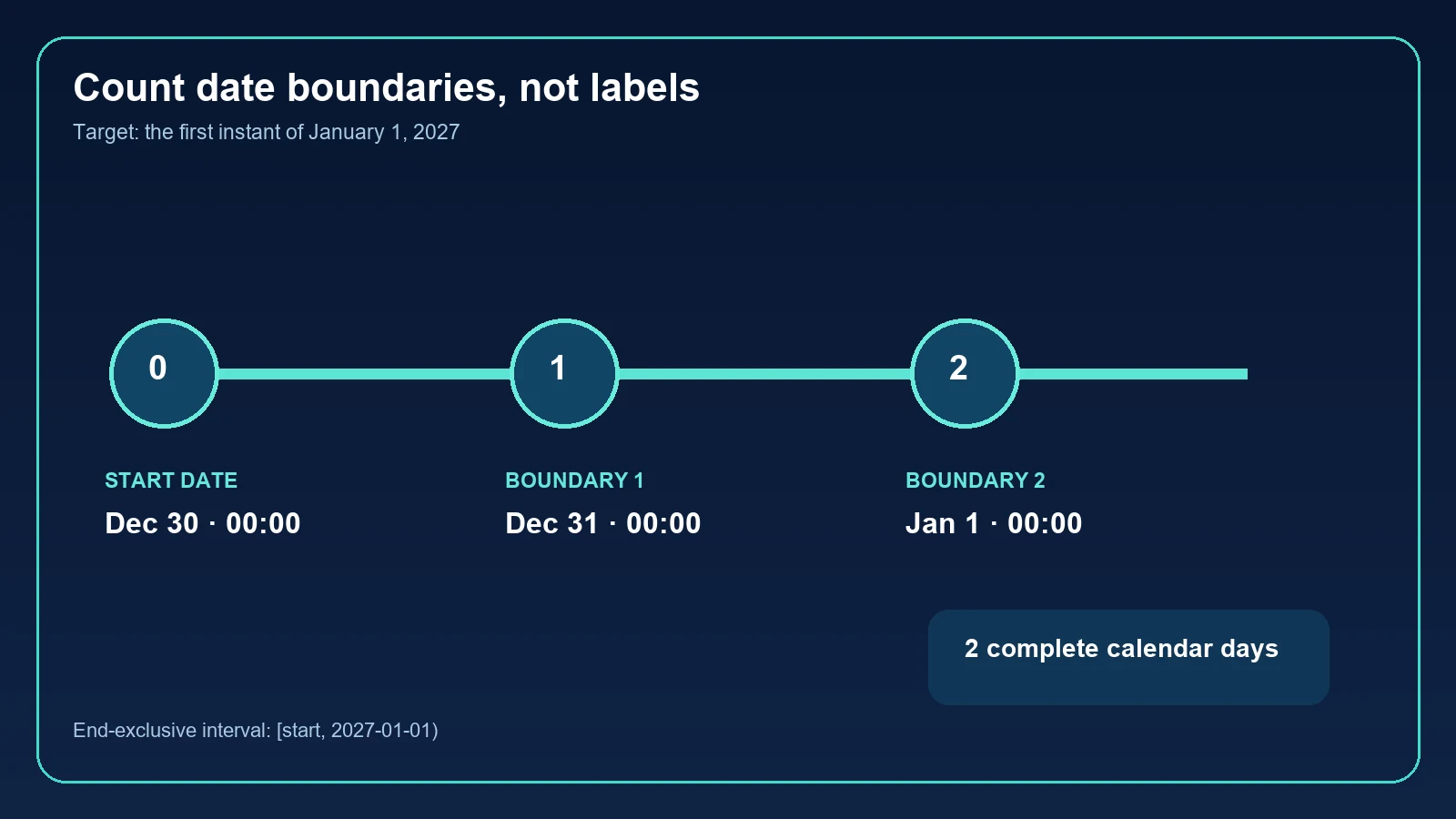
For a date-only calculation, choose a start date and subtract it from 2027-01-01. Most date libraries and spreadsheets treat that as an end-exclusive interval: the start is the beginning of the chosen day and the target is the beginning of January 1. If the start is December 30, the result is two date boundaries—December 31 and January 1.
For a live countdown, use timestamps instead:
1. Construct January 1, 2027 at 00:00:00 in the chosen timezone.
2. Subtract the current timestamp.
3. Divide the positive difference into days, hours, minutes, and seconds.
4. Stop at zero instead of displaying a negative countdown.
Do not divide a millisecond difference by 86,400,000 and call it a calendar-day answer without considering timezone changes. Some locations have daylight-saving transitions, so a local calendar day can contain 23 or 25 elapsed hours. The NIST explanation of daylight saving time distinguishes civil-time changes from the underlying progression of time.
Should today be included?
Include today when the question is “On how many dates can I still perform this task?” and today remains usable. Exclude the current partial day when the question is “How many complete days of time remain?” For example, at midday, a live display has already consumed half of today; a checklist may still contain today as one actionable row.
A useful written convention is: “Calendar dates from September 7 through December 31, inclusive.” A useful timer convention is: “Elapsed time until local midnight starting January 1, 2027.” Those phrases make the result auditable months later.
The Gregorian calendar rule is stable: years divisible by four are leap years, except century years not divisible by 400. The U.S. Naval Observatory calendar reference explains the rule. Because 2027 is not divisible by four, it is a 365-day common year; that fact describes 2027 itself, not necessarily the interval leading up to it.
How do days become weeks and working days?
To express a whole-day count as weeks, divide by seven. If 115 whole days remain, that is 16 complete weeks plus 3 days because 115 = 16 × 7 + 3. Writing “about 16.4 weeks” is compact, but the quotient-and-remainder form is more useful for a calendar plan.
Working days require more information. First remove Saturdays and Sundays if those are non-working days. Then remove holidays for the relevant country, region, and organization. Do not silently use one nation’s calendar for an international audience. A company closure day, a Friday–Saturday weekend, or a half-day policy can change the result.
| Planning question | Calculation |
|---|---|
| Complete weeks remaining | whole days ÷ 7, retain remainder |
| Typical Monday–Friday days | count weekdays in the interval |
| Organization workdays | weekdays minus named closures |
| Hours remaining | use timestamp difference, not date labels |
Why do timezones change the answer?
New Year arrives by local civil time. Auckland, New Delhi, London, and New York do not cross into 2027 simultaneously. A person traveling can even see the displayed day count change when the device timezone changes, although the destination remains “local midnight.”
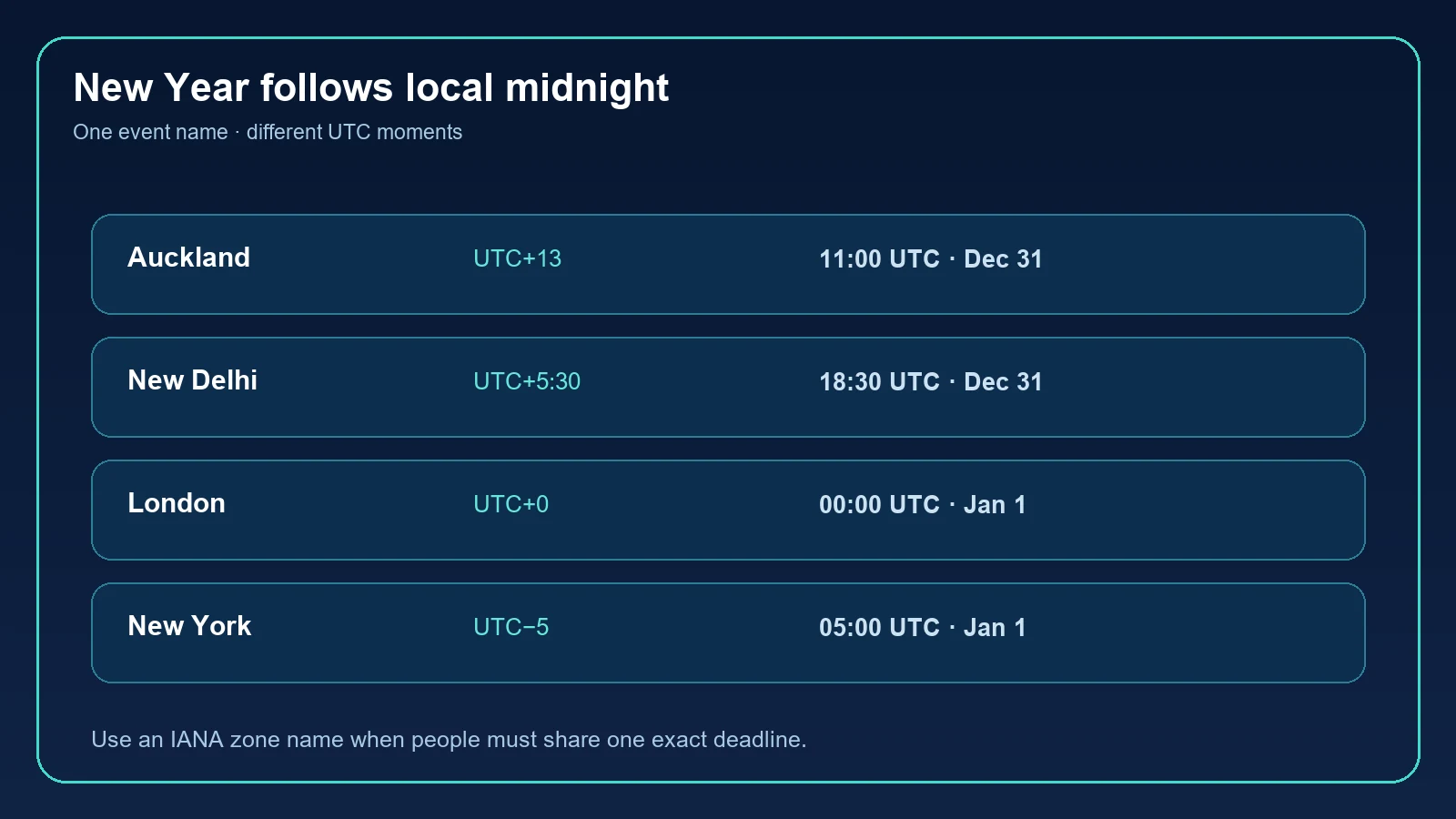
For a shared international launch, replace “local midnight” with a single named zone or UTC timestamp. The IANA Time Zone Database records the civil-time rules used by software. Prefer an area name such as Asia/Kolkata or America/New_York over a bare abbreviation, because abbreviations can be ambiguous and fixed offsets do not capture every seasonal rule.
What should you record with the result?
Record the check time, timezone, target boundary, inclusion convention, and whether the number is calendar days or workdays. If the value will appear in a contract, shipping promise, or regulated filing, use the governing document’s definition instead of a general-purpose countdown.
For ordinary planning, a live timer plus a dated snapshot is enough. The timer answers “how long now?” while the note explains why the saved number may differ tomorrow. That pairing turns a fleeting countdown into a result another person can reproduce.
Frequently Asked Questions
When does the countdown to 2027 end?
It ends at 12:00 a.m. on January 1, 2027 in the timezone used by the countdown. People in different timezones reach that boundary at different moments.
Should I include today when counting days until 2027?
For an elapsed-time countdown, do not count the current partial day as a complete remaining day. For a checklist of available calendar dates, you may include today, but label that convention.
How do I convert days until 2027 into weeks?
Divide the remaining whole days by seven. The quotient is complete weeks and the remainder is extra days; a decimal week is useful only as an estimate.
Are weekends included in the days until 2027?
Yes in a calendar-day countdown. A working-day count needs a separate rule for weekends and a named holiday calendar.
Is 2027 a leap year?
No. Under the Gregorian rule, 2027 is not divisible by four, so it has 365 days.

About The Author
Vigneshwaran Vijayakumar
Founder, Developer and Publisher of ClockTools | Digital Marketing Manager | India
Vigneshwaran is an engineer with decades of technical experience, including professional work as a Digital Marketing Manager in Dubai. His work connects data analysis, search engine optimization, conversion-rate optimization, content systems, visual production, and applied AI and machine learning. At ClockTools, he turns that multidisciplinary experience into focused browser utilities and practical, source-aware guides.