Randomizer Tools
What Is the Best Strategy for Rock Paper Scissors?
The game-theory answer, a practical opponent-reading protocol, and the limits of “winning” tips.
By Vigneshwaran Vijayakumar, Developer and Publisher | | Reviewed under the ClockTools editorial policy

Table of contents
The safest Rock Paper Scissors strategy is to choose rock, paper, and scissors independently and with equal probability. That does not guarantee a win in one round. It prevents an opponent from earning a predictable long-run advantage from your move frequencies. If a particular human shows a real pattern, you can adapt—but the evidence should come before the counter-move.
Use the ClockTools Rock Paper Scissors game to run a quick match or a longer experiment. Its computer choice uses browser cryptographic randomness, so it is a better baseline than asking a friend to “act random.” For another transparent random choice, Roll A Dice can map three equally likely results to the three moves.
Why is one-third each the defensive baseline?
Rock beats scissors, scissors beats paper, and paper beats rock. Every pure move therefore has one winning matchup, one losing matchup, and one tie. If you play rock too often, an opponent can increase paper. If you then over-correct toward scissors, the opponent can increase rock. No fixed favorite survives an informed response.
The equilibrium is a mixed strategy: choose each action with probability 1/3 and make each round independent of the last. An introductory game-theory treatment of repeated Rock Paper Scissors shows why uniform random play leaves the opponent without a profitable frequency adjustment. Independence matters as much as balance. A sequence that cycles rock, paper, scissors has equal totals but is perfectly predictable.
What does the payoff matrix prove?
Assign +1 to a win, 0 to a tie, and −1 to a loss. The rows below are your moves; the columns are the opponent’s.
| Your move | Opponent rock | Opponent paper | Opponent scissors |
|---|---|---|---|
| Rock | 0 | −1 | +1 |
| Paper | +1 | 0 | −1 |
| Scissors | −1 | +1 | 0 |
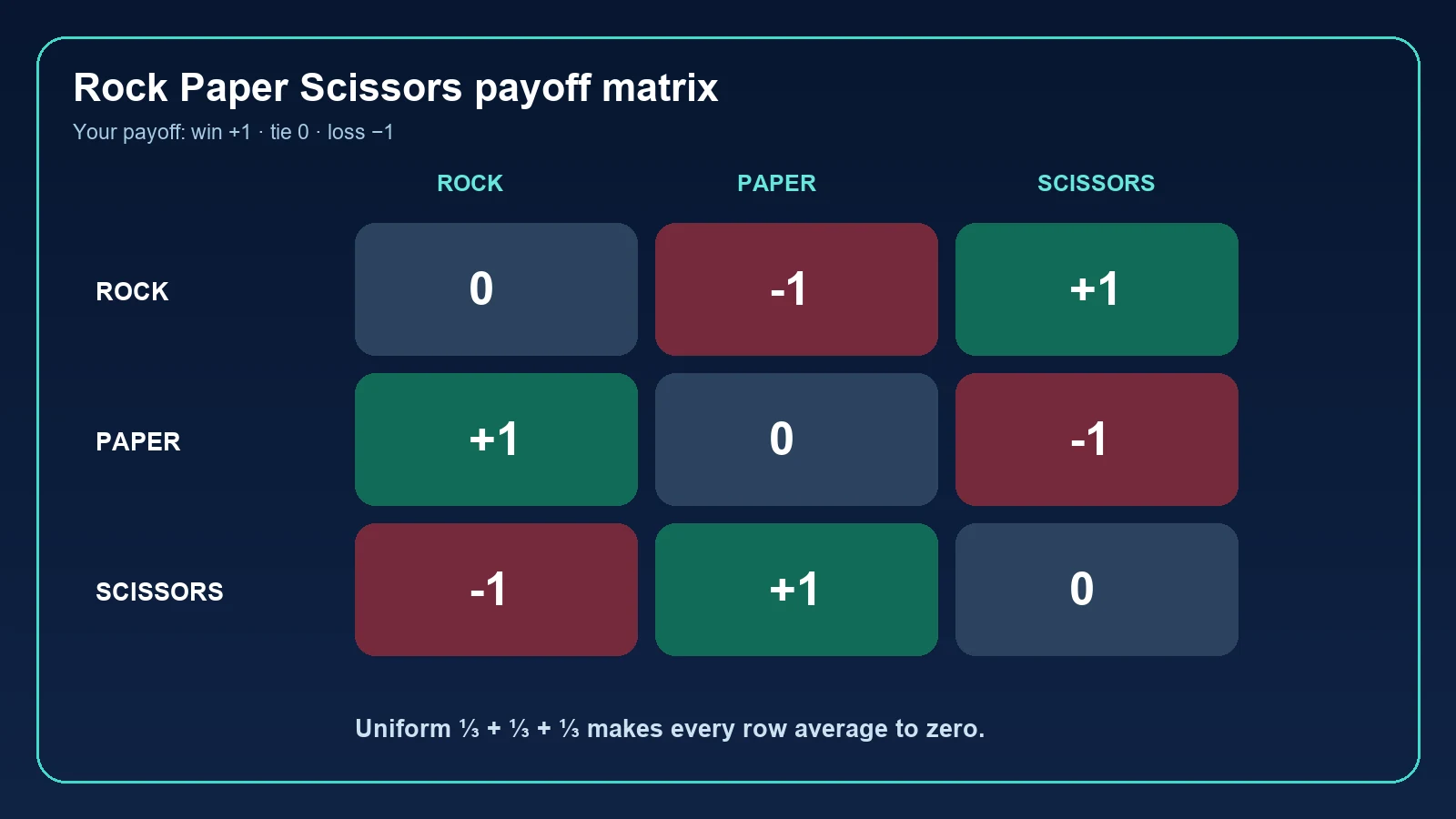
Against an opponent who also uses one-third each, the expected payoff of every row is (0 − 1 + 1) / 3 = 0. Switching from rock to paper cannot improve the expectation, because the opponent’s mix gives every move the same average. This is a protection claim, not a victory promise: variance still produces streaks.
Research also distinguishes a single encounter from repeated play. A 2026 Scientific Reports study of non-transitive games describes the unique uniform equilibrium for the symmetric one-shot game while analyzing how sequential structure can create learnable behavior. The practical lesson is simple: randomize when you lack evidence; model only patterns that persist.
Why are humans often predictable?
People struggle to generate independent random sequences. We may avoid repeating a move because repetition “looks” non-random, alternate after a loss, or reuse a recent winner. But a population tendency is not a reliable diagnosis of the person in front of you. Advice such as “people open with rock” can become self-defeating once both players know it.
Repeated-game studies find conditional behavior rather than one universal script. A large-scale analysis of online matches in Games reported systematic deviations from equilibrium, while the useful prediction depends on the opponent and context. Any exploitation rule should therefore be temporary, measured, and reversible.
How can you test an opponent pattern?
Start with the uniform strategy and record rounds without announcing your hypothesis. Choose one narrow question—for example, “After a loss, does this opponent switch to the move that would have beaten mine?”—rather than searching for any pattern after the fact.
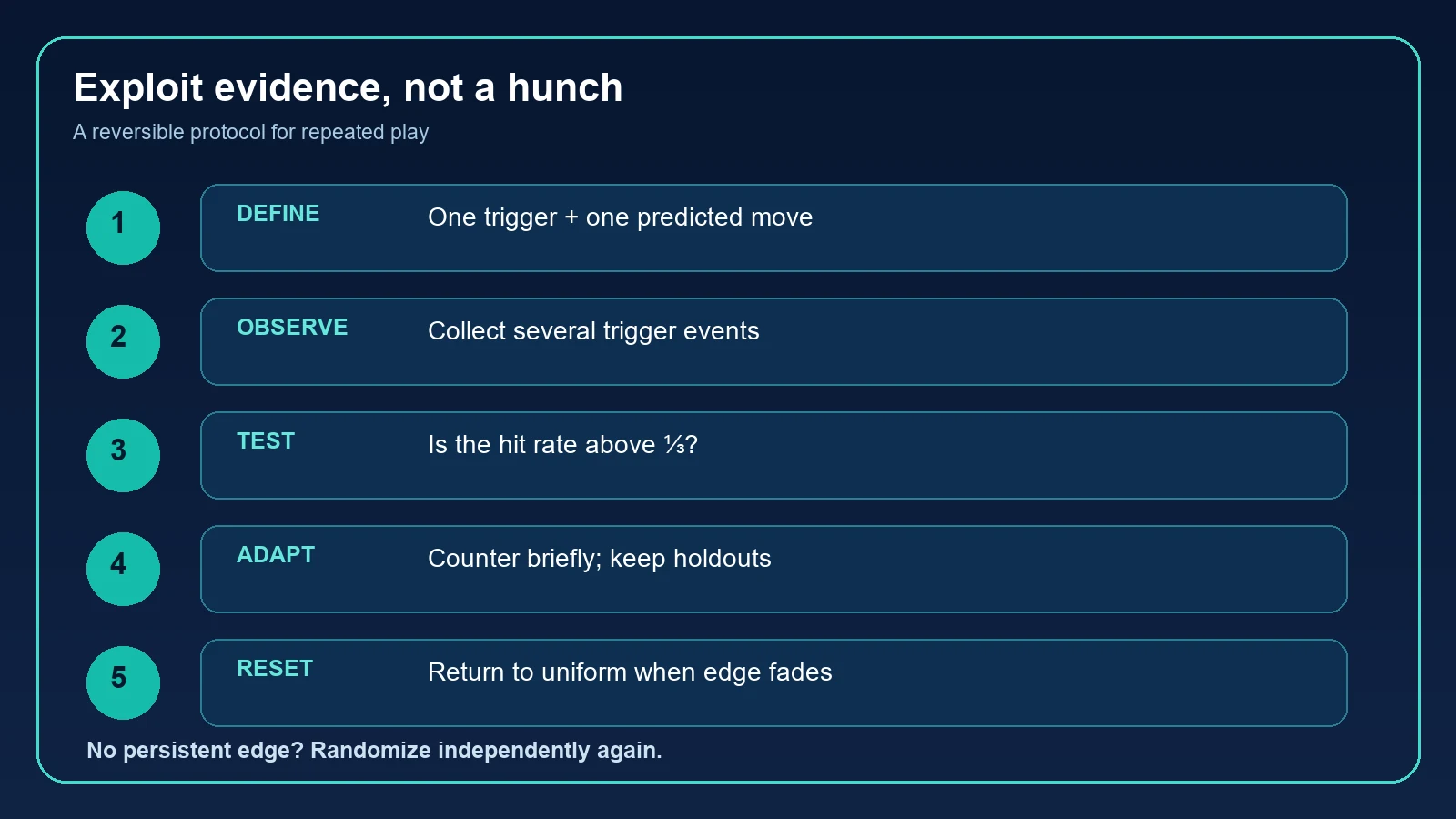
1. Define the trigger and predicted next move before collecting the sample.
2. Observe enough trigger events to avoid treating two occurrences as a law.
3. Use the counter only while the hit rate remains meaningfully above one-third.
4. Return to uniform random play when the edge disappears.
5. Keep holdout rounds where you do not exploit, so adaptation is easier to notice.
This is lightweight opponent modeling. A 2021 study in Entropy demonstrates that models can target behavioral regularities, but a casual player should avoid false precision. Your rival may change strategy as soon as they suspect you are reading them.
Which popular strategy claims are too strong?
“Never repeat,” “always repeat a winner,” and “throw paper first” are conditional heuristics presented as universal laws. Each creates a pattern if followed mechanically. A deterministic anti-pattern is still deterministic.
Gesture-reading claims also need care. In a fair simultaneous game, both choices should lock before reveal. Watching a hand shape and changing late is not strategy; it changes the rules. Agree on the cadence, reveal together, and replay ambiguous rounds.
The statement “random play cannot lose” is also wrong. It can lose many individual rounds. What uniform randomization does is hold the expected score to zero against any fixed opposing mix when wins and losses have symmetric value.
How can ClockTools support a fair experiment?
Choose Quick for isolated rounds or Best of 3, Best of 5, or Endless for a sequence. The visible 3-2-1 countdown separates selection from reveal, and choices lock during play. Local history and statistics help summarize a session without implying that past rounds control the next random computer move.
Before starting, decide whether ties replay or count as rounds, whether the match ends on a required number of wins, and whether you are studying an opponent or just selecting a winner. Clear rules prevent a post-hoc change from masquerading as clever strategy.
The best practical strategy is two-layered: use uniform independent choices as the default, and make small, reversible deviations only when a defined pattern has survived observation. That is less theatrical than a secret winning move—and much harder to exploit.
Frequently Asked Questions
What is the safest Rock Paper Scissors strategy?
Choose rock, paper, and scissors independently with equal probability. That mixed strategy prevents an opponent from gaining a long-run edge from your choice frequencies.
Is rock the best first move?
No move is universally best. A population may favor one opener, but a known bias can change and an alert opponent can exploit your counter-bias.
Can you guarantee a win in Rock Paper Scissors?
No. Against an unpredictable opponent, each round can be a win, loss, or tie. Sound strategy protects your expected result rather than guaranteeing one outcome.
Should you repeat a winning move?
Only if you have evidence that this particular opponent responds predictably. Treat “win-stay” rules as hypotheses and abandon them when observations do not support them.
How can I choose randomly without a computer?
Privately map three equally likely outcomes—such as a shuffled set of three cards—to rock, paper, and scissors, and redraw independently each round.

About The Author
Vigneshwaran Vijayakumar
Founder, Developer and Publisher of ClockTools | Digital Marketing Manager | India
Vigneshwaran is an engineer with decades of technical experience, including professional work as a Digital Marketing Manager in Dubai. His work connects data analysis, search engine optimization, conversion-rate optimization, content systems, visual production, and applied AI and machine learning. At ClockTools, he turns that multidisciplinary experience into focused browser utilities and practical, source-aware guides.