Roman numeral converter

Convert 1–3,999 to canonical Roman numerals or validate Roman text. Inspect the symbol breakdown and copy or download the conversion.

How to use

Convert 1–3,999 to canonical Roman numerals or validate Roman text. Inspect the symbol breakdown and copy or download the conversion.

Step 1

Choose decimal or Roman input

Fixed example

49XLIX

Use Number to Roman for whole digits from 1 through 3,999, or Roman to number for text made from I, V, X, L, C, D and M. Lowercase letters and Unicode compatibility Roman characters are normalized before validation.

Step 2

Read the place-value breakdown

Fixed example

CM + XL + IV900 + 40 + 4

A valid result shows the total and the tokens that produced it, such as CM, XL and IV for 944. A rejected string is not assigned a guessed value.

Step 3

Copy, download or reverse-check

Fixed example

944CMXLIV944

Use Swap direction after a valid conversion when you want to check the other reading. Copy and Download keep the number, Roman form and token breakdown together.

Practical uses

Chapter, outline and release numbering

For a document whose 49th section needs a Roman heading, select Number to Roman and enter 49. The result XLIX separates 40 and 9; IL is rejected rather than treated as an alternative abbreviation. Use Swap direction to check that XLIX returns 49 before inserting the heading. If a publishing style uses lowercase roman numbering, apply that typography in the document: the converter's output remains uppercase. Keep numbering stored as ordinary integers when sorting or renumbering an outline; printed Roman strings are labels, not a useful numeric sort order.

Design dates and inscriptions

For an engraving proof showing the year 2026, enter 2026, check MMXXVI, and read the breakdown M + M + X + X + V + I. Swap the valid result to confirm the integer before committing the design. Keep the decimal year alongside the proof; a missing X changes the value rather than merely changing its appearance. If you also need a day and month, convert each intended component separately and choose separators in the design. This tool converts one integer, not an entire date string or a historically styled inscription.

Transcription checks without rewriting history

A museum caption for a photographed clock should retain IIII if that is what the dial shows. Roman to number will reject that additive spelling because the selected grammar uses IV; it will not suggest that the photograph must be changed. Record the observed form and, if helpful, a separate note giving the value four. The same distinction matters when quoting a title, cataloging an artifact or checking OCR. Compare doubtful letters with the original image before normalizing them, since an apparent X may be a different character or a damaged mark.

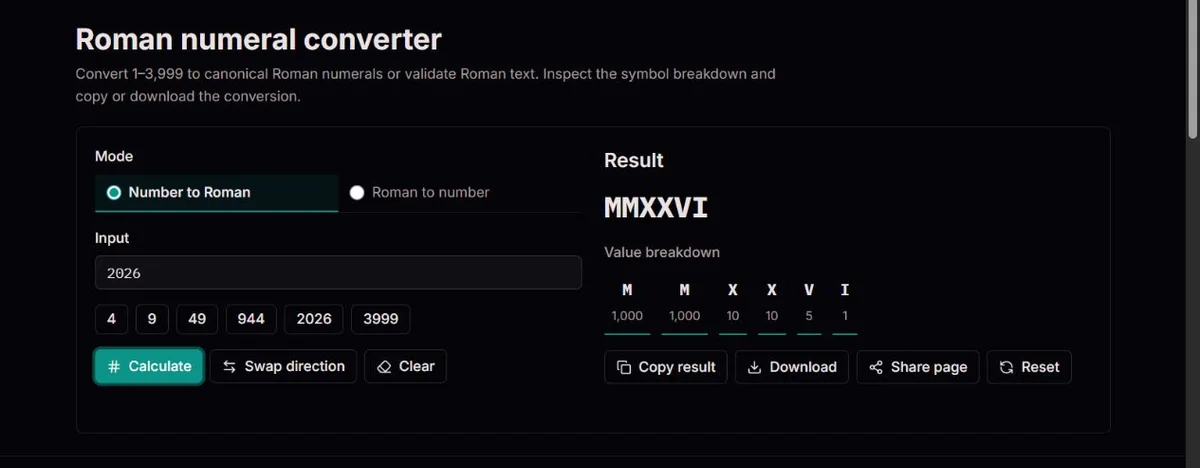
2026 converted to MMXXVI with its symbol values
The example converts 2026 to MMXXVI. The breakdown shows 1,000 + 1,000 + 10 + 10 + 5 + 1, so you can check the result rather than only copy it.

How the converter reads Roman numerals

The working grammar is deliberately narrow: seven Latin letters, descending place groups and six approved subtractive pairs. That makes the result predictable for modern chapter numbers, dates and examples, while avoiding a false claim that every historical Roman inscription used the same spelling.

The seven symbols are I, V, X, L, C, D and M. The converter groups them by thousands, hundreds, tens and ones, so each place can be checked independently before the value is added to the total. This is why 944 is read as CM + XL + IV rather than as a free-form smaller-before-larger rule.

Roman input is trimmed, compatibility Roman numeral characters from the Unicode Number Forms block are normalized to ordinary Latin letters, and the result is uppercased. Other lookalike letters and overline marks are rejected. The Unicode Number Forms chart lists compatibility mappings such as Ⅹ to X, but that does not make every numeric-looking character part of this tool's grammar.

944CMXLIV944
Fixed breakdown: 944 is CM + XL + IV, or 900 + 40 + 4.

Seven symbols, four place groups

The decimal-to-Roman side walks a fixed token list from M down to I. It subtracts the largest available token until the remaining value is zero. Because the range stops at 3,999, the thousands group can contain M, MM or MMM, but never an overlined V or another extended notation.

The Roman-to-number side first proves that the entire string fits the same place grammar. Only then does it add token values. This order matters: it prevents IIV, IL or IM from receiving a convenient but unsupported value.

The breakdown displayed on the page is therefore diagnostic. If 2026 becomes MMXXVI, the pieces are M, M, X, X, V and I. If 49 becomes XLIX, the pieces are XL and IX. Those tokens are the exact units the engine used, not a separate teaching approximation.

The basic values are I = 1, V = 5, X = 10, L = 50, C = 100, D = 500 and M = 1000. Repeating a permitted symbol adds its value: III is three, XX is twenty and MMM is three thousand. V, L and D are not repeated in this grammar. A zero decimal place simply contributes no group: 2026 has no hundreds group, whereas 2006 has neither hundreds nor tens. That absence is different from having a Roman symbol for zero.

Canonical place groups used by this converter
PlaceAccepted patternsExamples and consequences
ThousandsM, MM, MMM1,000 to 3,000 are ordinary M repeats; 4,000 is outside the supported range.
HundredsC, CC, CCC, CD, D, DC, DCC, DCCC, CM400 is CD and 900 is CM; forms such as CCCC or DM are rejected.
TensX, XX, XXX, XL, L, LX, LXX, LXXX, XC40 is XL and 90 is XC; IC is not accepted for 99.
OnesI, II, III, IV, V, VI, VII, VIII, IX4 is IV and 9 is IX in this grammar; IIII is preserved only as source notation outside conversion.

Allowed subtraction is local, not arbitrary

Only I before V or X, X before L or C, and C before D or M are accepted as subtractive pairs. The pair belongs inside its own place group. That keeps IV, IX, XL, XC, CD and CM valid while rejecting shortcuts that skip a place.

A useful worked example is 944. The hundreds place is CM for 900, the tens place is XL for 40, and the ones place is IV for 4. The complete result is CMXLIV. Writing IM for 999 or XM for 990 looks shorter, but it bypasses the place groups the tool enforces.

The error message is intentionally conservative. If the letters are valid but the order is not canonical, the page reports a syntax error and no value is inferred. That is safer than silently turning an editorial problem into a different number.

Common checks for tempting shortcuts
InputAccepted?Why it matters
XLIXYesXL contributes 40 and IX contributes 9, so the total is 49.
ILNoI may subtract only from V or X, not from L.
IIVNoThe ones group cannot stack I before IV to invent 3.
CMXLIVYes944 uses three valid place groups: CM, XL and IV.
MMMMNoThe ordinary-letter range ends at 3,999.

What normalization and errors mean

Number mode accepts decimal digits only. Enter 1000, not 1,000, 1.000 or 1 000: a locale's grouping mark is still a non-digit in this field. Leading zeros such as 0049 are accepted and convert to XLIX, but signs, fractions and exponent notation are not. Empty input simply leaves the result empty; 0 and 4000 exceed the numeric range. The input is limited to 64 characters, so pasting a paragraph is not a way to ask for several conversions.

In Roman mode, lowercase Latin letters are uppercased and the Unicode compatibility block U+2160 through U+217F is normalized. Thus ⅩⅣ can become XIV. A Cyrillic Х followed by IV is rejected because it is not the Latin X, and X with a combining overline is rejected because overlines are not supported. Leading and trailing whitespace is removed, but spaces inside a numeral are not: XIV is a numeral here, while X IV is not a batch of two values.

Two different Roman errors are useful. A letter error means the characters themselves are outside I, V, X, L, C, D and M after the narrow normalization pass. A syntax error means the characters are allowed but the order or subtractive pair does not match the canonical grammar.

Current input outcomes
Input typeOutcomeCorrection path
2026 in number modeValid: MMXXVIUse Copy or Swap direction to recheck the Roman output.
ⅩⅣ in Roman modeValid after compatibility normalization: XIVKeep plain Latin letters when exporting to systems with limited font support.
ХIV with Cyrillic ХLetter errorReplace the lookalike with Latin X if the intended text is XIV.
IIIISyntax errorUse IV for canonical conversion, or preserve IIII as clock/source notation.
X with an overline markLetter errorChoose a tool and convention that explicitly supports overlined values.

When not to normalize the source

Conversion and transcription answer different questions. Conversion asks what value a string has under this page's modern grammar. Transcription asks what the source actually shows. For a manuscript, monument, watch dial, brand mark or image caption, keep the observed spelling before deciding whether to add a normalized note.

Clock faces are the common example. The Seiko Museum describes many clocks using IIII at the four o'clock position and presents more than one explanation for that convention. This page should not turn those possibilities into a single origin story.

The practical rule is simple: use the converter for a planned modern spelling, and use the source text for a source record. If both are needed, write them separately, such as source: IIII; normalized value: 4. That keeps the editorial decision visible.

Clock notation and editorial context

A clock dial is not merely a number line. It is also a physical layout with symmetry, material constraints and inherited design conventions. A dial reading IIII can be completely intentional even when a textbook table would list IV.

Do not correct a photographed clock, catalog record or quotation just because the converter rejects IIII. The safer workflow is to record the source spelling, add the numeric value if useful, and explain that the converter is using canonical modern subtraction.

The same caution applies to names and titles. If a game, movie, ship, building or product intentionally styles a number in a noncanonical way, retain the title as published. You can convert a separately known integer into a canonical comparison, but the tool will not infer an intended value from the rejected title spelling. A conversion is not authority to rename a work.

Transcription versus conversion decisions
TaskBest field to keepWhy
Museum label for a dialIIII as observed, plus value 4 if neededThe visible artifact is the evidence.
New chapter headingIVThe author is choosing a canonical modern spelling.
Engraving proof for a yearMMXXVI and decimal 2026The decimal source helps catch a misplaced Roman letter before production.
Quoted title with unusual stylingThe title spelling, unchangedA converter result is not authority to rename the work.

Worked checks and troubleshooting

Start with the smallest disputed part. If MCMXCIX is hard to read, split it as M + CM + XC + IX. The total is 1,000 + 900 + 90 + 9, or 1,999. If a pasted form fails, check whether the failing character is a lookalike rather than a Latin Roman letter.

For a date such as 2026, the converter returns MMXXVI. The thousands group is MM, the tens group is XX and the ones group is VI. There is no hundreds group because the hundreds digit is zero. Roman numerals in this tool do not use a placeholder for zero.

When a value seems too large, check whether the source used an overline or another extension. This page implements none of those extensions. Removing the marks to make the text validate is not an equivalent conversion: the source's chosen notation may give those marks meaning. Establish that convention and use a supporting tool instead of reporting an unsupported paste as a wrong arithmetic result.

Fixed examples worth checking both ways
DecimalCanonical RomanBreakdown
4IV4 as one subtractive pair.
49XLIX40 + 9; not IL.
944CMXLIV900 + 40 + 4.
2026MMXXVI1000 + 1000 + 10 + 10 + 5 + 1.
3999MMMCMXCIXHighest supported value without overlines.

Methodology

Number mode accepts only whole decimal digits from 1 through 3,999 and converts by subtracting fixed tokens from M through I. Roman mode trims the input, normalizes Unicode compatibility Roman characters from U+2160 through U+217F, uppercases Latin letters, requires only I, V, X, L, C, D and M, then validates the full canonical thousands-hundreds-tens-ones grammar before calculating a value.

Limits

The converter does not parse zero, negative numbers, fractions, additive clock notation, medieval or inscriptional variants, apostrophus forms, overlines, parentheses used as multipliers or values above 3,999. It does not infer a value from malformed text, and it does not treat Greek, Cyrillic or other lookalike letters as Latin Roman symbols.

Corrections

For a reproducible report, include the exact input, conversion direction, copied characters if special symbols are involved, expected conventional form and why that convention applies. If the source uses IIII, overlines or another historical notation, preserve the original source text and report the unsupported convention separately from arithmetic errors.

Frequently asked questions

Why does the converter reject IIII?
Four is IV in the converter's selected grammar. A clock showing IIII is using another notation convention, not necessarily displaying a wrong number. For a new canonical heading use IV; for a transcription keep the observed IIII and add an explanatory value if needed. The tool does not infer values from additive source notation or automatically rewrite it.
Which subtractive pairs are allowed?
Only IV, IX, XL, XC, CD and CM, within their own place groups. To write 99, use XCIX, not IC; to write 49, use XLIX, not IL. The tempting shorter strings skip a place and fail the declared grammar. A syntax warning gives no guessed total, so return to the intended integer or original source before correcting the string.
Does the breakdown add individual letters or subtractive pairs?
It adds validated tokens. For CMXLIV the tokens are CM = 900, XL = 40 and IV = 4, not six unrelated letter values. An ordinary repetition such as MM appears as two M tokens, each worth 1000. Read the approved pairs as units before summing; otherwise adding every visible letter would give the wrong total.
Can I paste Unicode Roman numerals such as ⅩⅣ?
Yes, those compatibility forms become XIV and can validate. That normalization is narrowly limited to U+2160 through U+217F. It does not translate all numeric symbols or turn a Cyrillic Х into Latin X. If a visually identical paste fails, retype the intended Latin letters and compare the result with the source. For interchange, ordinary letters usually avoid dependence on special numeral glyphs.
Why are zero and 4,000 unsupported?
This ordinary-letter grammar covers 1 through 3999 and has no zero token. The limit is a converter boundary, not a claim that historical notation could not express larger numbers. For a value needing an overline or another extension, first establish the intended convention and use a tool that supports it explicitly. Removing the mark to make a paste validate can change its intended value.
Should I correct a historical source that fails validation?
Not automatically. Transcription records what is visible; conversion chooses a reading rule. Keep the observed letters, marks and styling, check the photograph or original for OCR errors, and put any normalized value in a separate note. A rejected clock form, official title or inscription is not evidence that you should rewrite the artifact or rename the work.
Why is 1,000 rejected while 1000 works?
Number mode requires digits without grouping punctuation. Enter 1000, regardless of whether your locale normally writes 1,000, 1.000 or 1 000. Leading zeros such as 0049 are accepted and do not change the integer, but a plus sign, decimal fraction or exponent expression is not accepted. The resulting Roman value is based on the integer, not its original display width.
Can I convert a whole date or several numerals at once?
No. The field handles one integer or one Roman numeral. Convert a date's day, month and year separately if that is the format you need, then add separators yourself. Pasting a sentence, a list or internal spaces produces a character or digit warning rather than separate results. A year like MMXXVI does not by itself encode which date format or calendar you intended.
What does Swap direction check, and what does Copy contain?
Swap is enabled for a valid result and moves that exact value into the opposite input mode, which is useful for catching an unintended numeral before reuse. It does not repair a rejected string. Copy and Download include the decimal value, Roman form and token breakdown together. Share sends the tool link only, not a conversion history or the current input.