Weather Calculator Tools
Does “Feels Like” Temperature Account for Humidity?
A controlled look at humidity, heat index, and apparent temperature.
By Vigneshwaran Vijayakumar, Developer and Publisher | | Reviewed under the ClockTools editorial policy
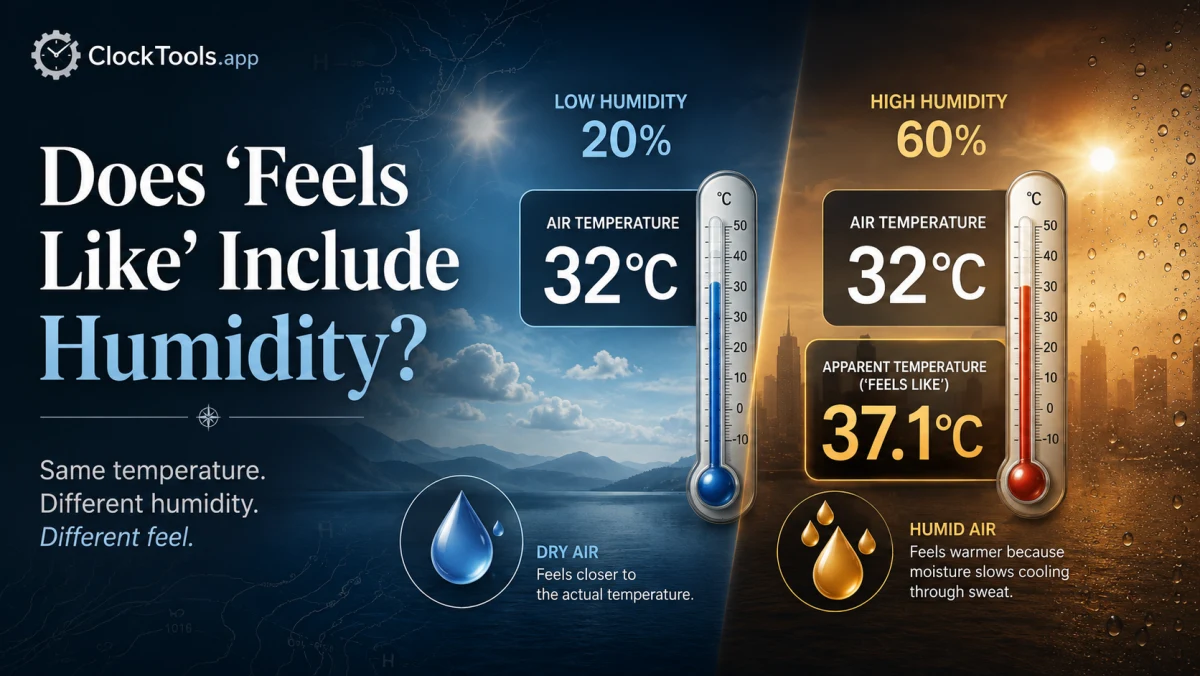
Table of contents
Yes—during hot weather, a feels-like value often uses relative humidity through the heat index. But “feels like” is a label, not one universal formula: cold-weather services may use wind chill, and some providers combine more variables. The ClockTools Heat Index Calculator isolates air temperature and relative humidity so you can see their effect.
Separate the label from the formula
Heat index estimates how hot the combination of air temperature and relative humidity feels to a person. Higher humidity slows sweat evaporation, reducing one of the body’s cooling mechanisms. The US National Weather Service heat-index guidance uses the Rothfusz regression under specified conditions.
| Display context | Common inputs | What to verify |
|---|---|---|
| Hot-weather heat index | Air temperature and humidity | Shade and light-wind assumptions |
| Cold-weather wind chill | Air temperature and wind | The provider’s wind-chill method |
| General apparent temperature | Provider-dependent variables | Formula and data source |
For the cold side of the distinction, how wind chill is calculated explains why humidity is not the central input there.
Hold temperature constant
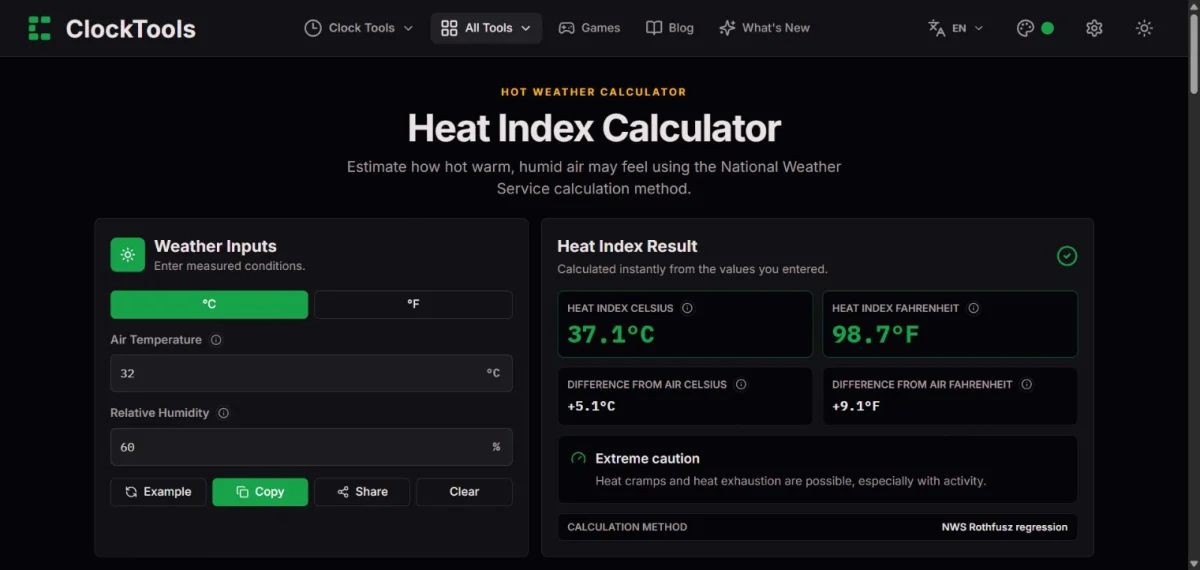
In the live ClockTools test, an air temperature of 32 C and relative humidity of 60 percent produced a heat index of 37.1 C (98.7 F). The displayed +5.1 C (+9.1 F) is the difference between that heat index and the air temperature. This is a worked example, not a forecast.
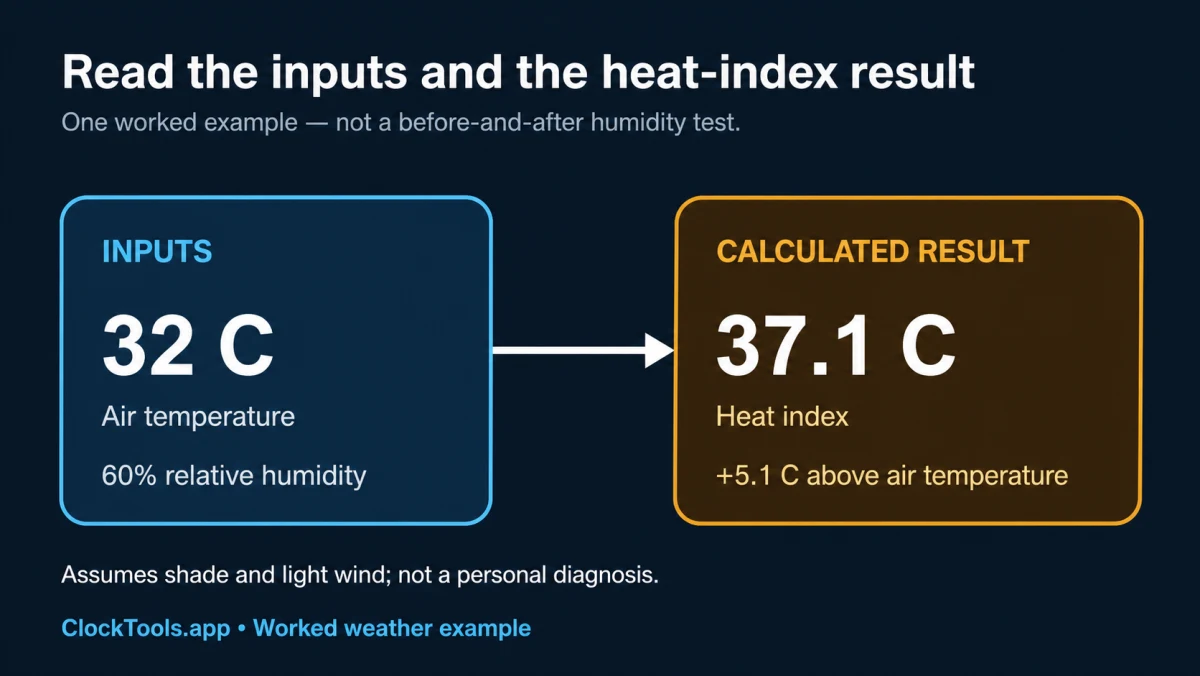
To explore humidity’s effect yourself, keep air temperature at 32 C, change only relative humidity, and compare the resulting heat-index values. This article records the 60 percent result only. Use the dew point calculator when you want a separate measure of atmospheric moisture; dew point and relative humidity answer different questions.
Know what heat index leaves out
The standard NWS heat index is calculated for shaded, light-wind conditions. The agency notes that full sunshine may increase the apparent value by as much as 15 F. Clothing, activity, acclimatization, radiant heat, and individual health are not fully represented by one outdoor index. A calculator result therefore supports judgment; it does not diagnose personal risk.
Weather providers may switch formulas by temperature range or location. When two services disagree, compare their inputs, update time, station, units, and stated method before deciding that either is wrong.
Use the result safely
Check an official local forecast and alerts before outdoor activity. Adjust timing, shade, water, rest, and workload to the conditions and the people involved. The CDC heat-illness guide lists warning signs and first actions.
Heat stroke is a medical emergency. Confusion, loss of consciousness, seizures, or very high body temperature require emergency help and rapid cooling. Do not wait for a calculator category to confirm an obvious emergency.
Frequently Asked Questions
Does a feels-like temperature include humidity?
Often yes in hot-weather heat-index calculations, but the label can refer to different formulas depending on the provider and conditions.
Is heat index measured in the sun or shade?
The standard National Weather Service heat index is based on shaded, light-wind conditions; direct sun can feel hotter.
Does heat index include wind?
The standard heat-index formula does not directly model strong wind; providers may use other apparent-temperature methods.
When is heat illness an emergency?
Confusion, loss of consciousness, or very high body temperature can indicate heat stroke; call emergency services and begin rapid cooling.

About The Author
Vigneshwaran Vijayakumar
Founder, Developer and Publisher of ClockTools | Digital Marketing Manager | India
Vigneshwaran is an engineer with decades of technical experience, including professional work as a Digital Marketing Manager in Dubai. His work connects data analysis, search engine optimization, conversion-rate optimization, content systems, visual production, and applied AI and machine learning. At ClockTools, he turns that multidisciplinary experience into focused browser utilities and practical, source-aware guides.