Timer Tools
25 vs 50 Minute Pomodoro: Which Focus Length Fits?
A practical crossover test for choosing shorter or longer focus intervals without pretending one duration is universally optimal.
By Vigneshwaran Vijayakumar, Developer and Publisher | | Reviewed under the ClockTools editorial policy
Table of contents
There is no evidence-backed universal winner between a 25-minute and a 50-minute focus block. Start with 25/5 when beginning is the hard part, the task has natural small units, or you often drift before half an hour. Test 50/10 when the work has a high setup cost and a 25-minute bell repeatedly breaks useful concentration.
The ClockTools Pomodoro timer includes both patterns: Classic uses 25/5 with a 15-minute long break, while Deep Work uses 50/10 with a 25-minute long break. Choose one preset for a matched session, record what happened, and compare outcomes instead of declaring the longer block more serious or the shorter block more disciplined.
What are you really choosing?
An interval controls two costs. Start cost is the resistance and setup required to begin. Restart cost is the effort needed to reconstruct context after a break. Shorter blocks reduce the commitment required to start but create more stopping points. Longer blocks create fewer interruptions but ask for a larger initial commitment and may allow unnoticed drift to continue.
Compare total cycles over the same elapsed window. Four rounds of 25/5 occupy 120 minutes before any additional long break. Two rounds of 50/10 also occupy 120 minutes. The clock time is equal, but the number of starts, stops, and opportunities to check progress is different.
| Task signal | Start with 25/5 | Start with 50/10 |
|---|---|---|
| You postpone starting | Strong fit | Larger commitment may add resistance |
| Work divides into small exercises | Natural checkpoints | May combine too many units |
| Setup or context loading takes several minutes | More repeated overhead | Fewer restarts |
| You lose focus before 25 minutes | Shorten further and define a smaller task | Do not lengthen yet |
| The 25-minute bell repeatedly interrupts productive work | Record the pattern | Test the longer block |
When does the shorter interval fit?
Use 25/5 for tasks where completion can be seen quickly: a set of practice questions, one editing pass, one inbox category, or a defined portion of revision. The near checkpoint can make an unpleasant task easier to begin. It also creates a regular moment to ask whether the planned task is still the task you are doing.
Short blocks expose drift sooner. If the timer ends and the intended page was untouched, the result is informative. Narrow the next task from “study chemistry” to “solve questions 1 through 4 and mark uncertain steps.” A smaller work unit makes the interval measurable.
The drawback is repeated context reconstruction. A programmer reopening a complex call chain or a writer rebuilding an argument may spend a meaningful part of each 25-minute block regaining the same state. If the break consistently lands just after the work becomes fluent, a longer fixed interval deserves a test.
When does the longer interval fit?
Use 50/10 for work with a visible warm-up: assembling reference material, loading a development environment, reading a dense proof, or completing a coherent drafting section. The extra time reduces the number of scheduled exits from that context.
Longer does not mean uninterrupted at any cost. If the task involves driving, cooking, machinery, health, or another safety condition, the real-world process outranks the timer. Stop when safety requires it. For ordinary desk work, define the block's deliverable before starting so that 50 minutes does not become an unobserved browsing session.
The ten-minute break should be a genuine state change. Stand, drink water, look away from the screen, or move to a different room. Opening a high-engagement feed may make the next start harder than the previous one. Record restart difficulty rather than assuming every break restores attention.
What does the current evidence support?
The official Pomodoro Technique site describes a broader planning, estimation, recording, and interruption-management system, not just a 25-minute countdown. That matters because changing interval length does not replace the work of choosing a concrete task and reviewing the result.
A 2025 study of 94 university students compared self-regulated, Pomodoro, and Flowtime break rules during a two-hour authentic study session. The open research report found no overall differences in productivity, task completion, or flow, while some time-course measures of fatigue and motivation differed. One study with one setting does not settle the best interval for every person or task.
The cautious conclusion is useful: fixed breaks are a tool, not a universal treatment, and the exact interval is a testable design choice. Do not turn a personal preference into a medical claim. If attention difficulties materially affect daily life, seek advice from a qualified professional rather than treating a timer preset as diagnosis or care.
How do you run a fair three-session test?
Choose one repeated task type and three sessions of the same 120-minute total window. Use 25/5 for the first session, 50/10 for the second, and whichever felt promising for a confirmation session. Keep the time of day, workspace, notification settings, and task difficulty as similar as practical.
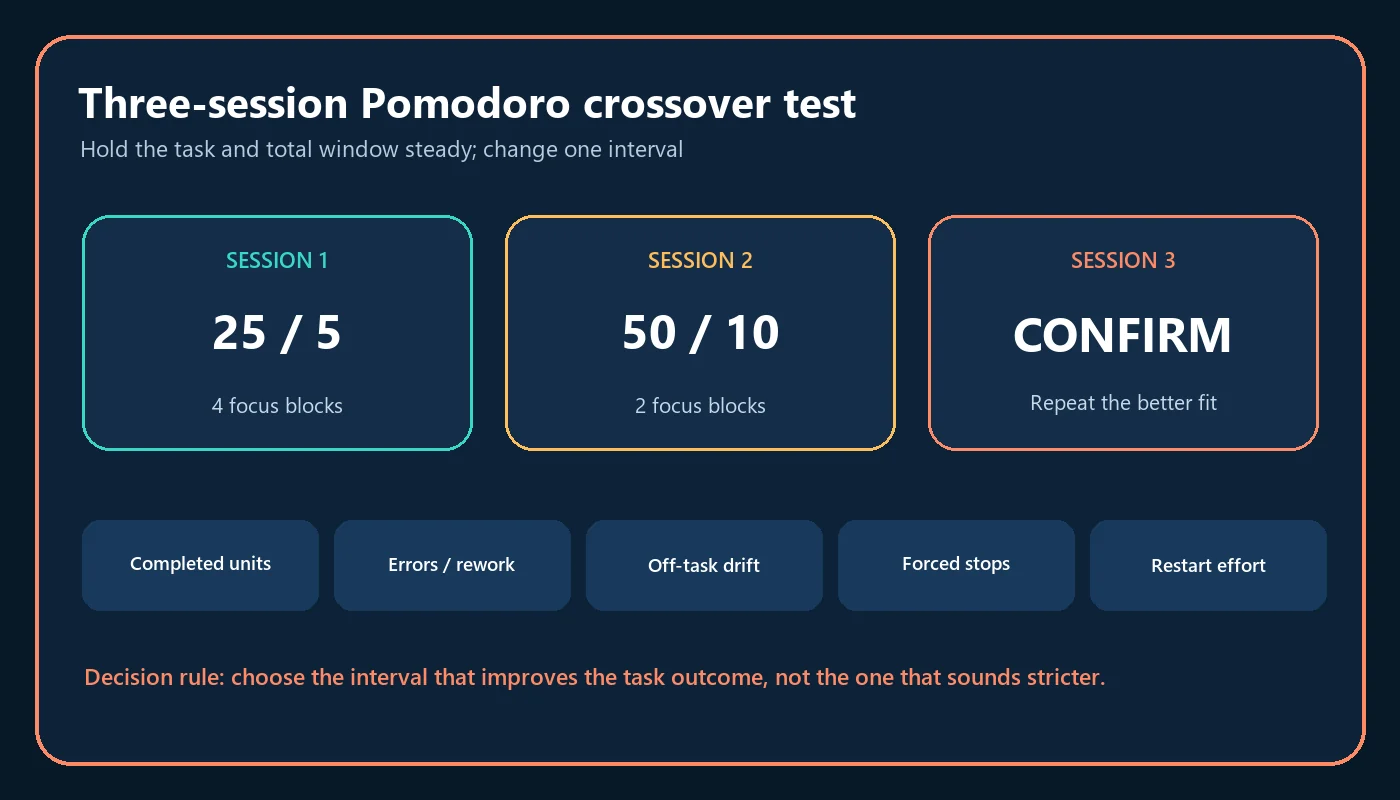
Before each session, define a countable unit: problems attempted, pages checked, cards reviewed, test cases completed, or draft sections revised. At the end, record five fields.
1. Completed units: how much of the planned work reached the defined finish line?
2. Errors or rework: how many units needed correction after the session?
3. Off-task drift: how many times did attention move to an unrelated activity?
4. Forced interruptions: how often did the timer stop a coherent step that needed reconstruction?
5. Restart effort: did the next focus block begin on time, slightly late, or not at all?
Do not create a single magic score unless the weights reflect your goal. For exam practice, correct completion may matter most. For drafting, preserving a coherent line of thought may outweigh raw section count. Compare the separate fields first, then make a decision you can explain.
How do ClockTools presets keep the comparison clean?
ClockTools provides three fixed patterns. Classic is 25 minutes of focus, 5 minutes of short break, and a 15-minute long break after four focus sessions. Deep Work is 50/10/25 with a long break after three focus sessions. Sprint is 15/3/10 with a long break after four sessions.
The timer can name the current task, auto-start the next phase, request notifications, enter fullscreen, and record today's completed focus sessions and focused minutes in local browser storage. Turn auto-start off for the first comparison if you need time to record the scorecard between phases. Keep it consistent across later sessions.
Use the online notepad for the five-field log if you want a simple local scratchpad. Do not paste private coursework, confidential client material, or sensitive personal notes into an unnecessary record.
How should you adjust the result?
If 25/5 produced more completed units with equal quality and easier restarts, keep it. If it created repeated forced interruptions and 50/10 preserved context without more drift, use the longer preset. If both failed because starting was difficult, test the 15/3 Sprint preset with a much smaller deliverable.
Change one variable for the next test. Altering interval length, break activity, task type, music, workspace, and auto-start together makes the result impossible to interpret. Recheck after the task changes; the best interval for vocabulary review may be the wrong interval for debugging.
The goal is not to prove loyalty to 25 or 50 minutes. It is to build a repeatable rhythm that starts on time, protects useful concentration, produces accurate work, and makes the next start possible.
Frequently Asked Questions
Is a Pomodoro always 25 minutes?
The classic interval is 25 minutes of focus followed by a short break, but people also test other fixed intervals. Keep the task, break rule, and measurement consistent when comparing lengths.
Is 50 minutes too long for a Pomodoro?
Not automatically. A 50-minute block may suit work with high restart costs if you can sustain attention and take a real break. It is a poor fit when you repeatedly drift or postpone starting.
Should a 50-minute focus block have a 10-minute break?
A 50/10 pairing is a reasonable preset to test, not a biological law. Use the break to disengage from the task, then compare completion, errors, and restart difficulty across sessions.
Can I use 20 minutes instead of 25 minutes?
Yes. If 25 minutes creates too much start resistance, a 20-minute fixed block can be tested. Do not change several variables at once if you want to learn which interval helps.
What if the timer interrupts me while I am focused?
Record that interruption as evidence. Finish a safe stopping point, take the planned break, and compare a longer preset in the next matched session rather than extending every block unpredictably.
Does Pomodoro improve productivity for everyone?
Current evidence does not establish a universal advantage or one optimal interval. Treat the timer as a structure to test against your task and study conditions, not a guaranteed performance treatment.

About The Author
Vigneshwaran Vijayakumar
Founder, Developer and Publisher of ClockTools | Digital Marketing Manager | India
Vigneshwaran is an engineer with decades of technical experience, including professional work as a Digital Marketing Manager in Dubai. His work connects data analysis, search engine optimization, conversion-rate optimization, content systems, visual production, and applied AI and machine learning. At ClockTools, he turns that multidisciplinary experience into focused browser utilities and practical, source-aware guides.